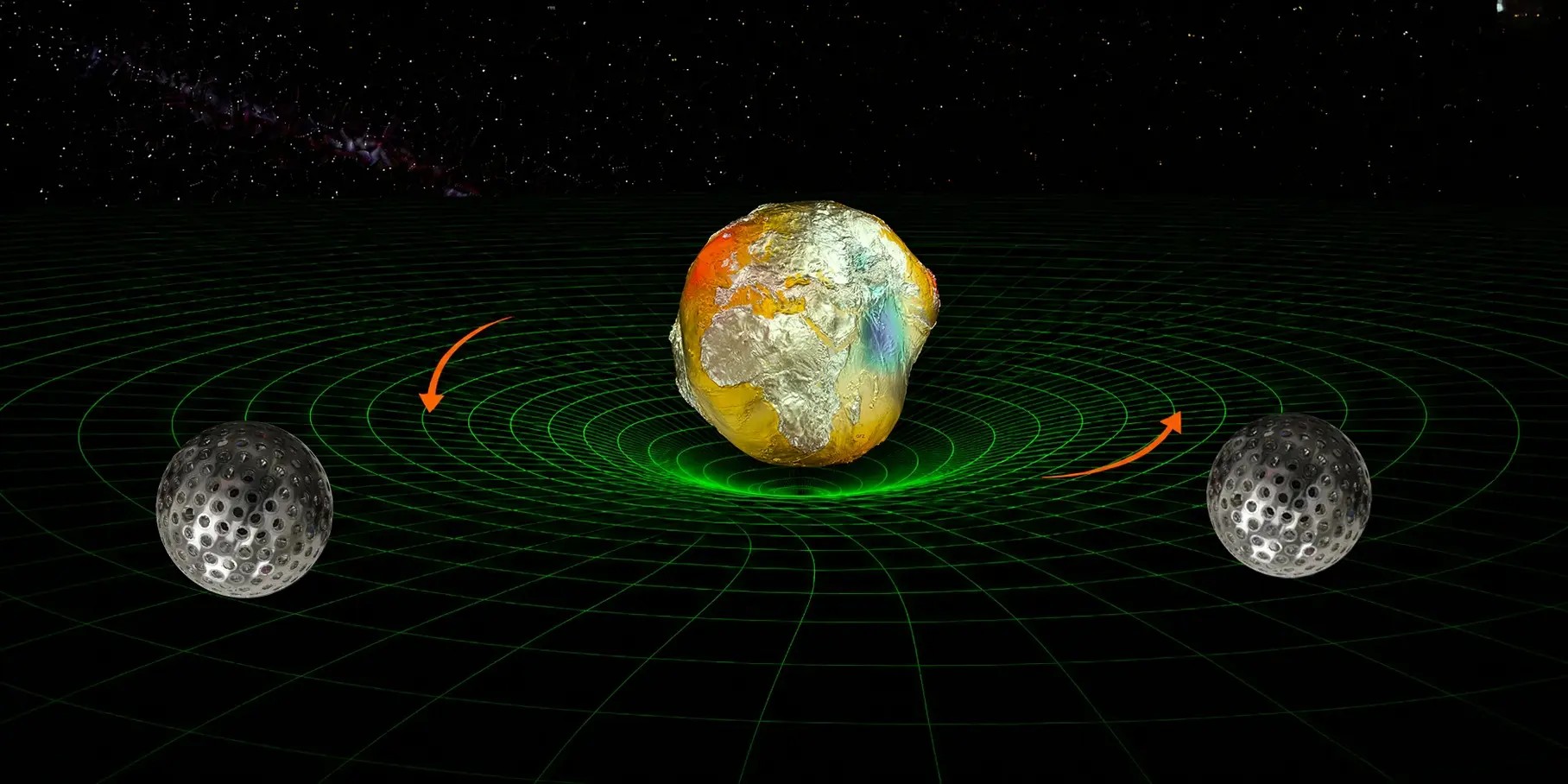
What does water storage on Earth have to do with Einstein’s theory of relativity? More than you might think. The GRACE and GRACE Follow-On satellite missions track tiny changes in Earth’s gravity field, revealing where large amounts of water and other mass are being redistributed around our planet. This knowledge of the gravity field is now helping with a very different experiment: a highly precise test of general relativity in Earth orbit.
An international research team has used the LARES-2 and LAGEOS satellites to measure how Earth’s rotation slightly drags the surrounding spacetime with it. This phenomenon, known as frame-dragging, is so subtle that it can only be detected through exceptionally precise satellite observations. Published in Nature, the new measurement has a relative uncertainty of about 0.2% – an approximately tenfold improvement over previous tests in the Solar System.
Dr Patrick Schreiner, GFZ Helmholtz Centre for Geosciences
GRACE measures mass, not water
When large amounts of water move around, Earth’s gravitational pull changes ever so slightly. GRACE and GRACE Follow-On can detect precisely these changes. Each mission uses two satellites flying one behind the other around Earth, measuring changes in the distance between them with extraordinary precision.
These measurements allow researchers to determine where mass is increasing or decreasing across the planet. Over land, much of this change is often due to water: groundwater, soil moisture, snow, ice, or water in lakes and rivers. The missions can therefore reveal, for example, whether groundwater reserves are shrinking, ice sheets are losing mass or water stores are replenishing after a drought.
GRACE does not ‘see’ water as a camera would. Instead, the satellites measure its effect on Earth’s gravity field. It is precisely this sensitivity to even the smallest shifts in mass that makes the missions valuable for applications which, at first glance, have nothing to do with water.
When Earth drags spacetime with it
Einstein’s general theory of relativity predicts that a rotating mass drags the spacetime around it ever so slightly. This phenomenon is known as frame-dragging, or the Lense–Thirring effect.
Near Earth, the effect is extremely small. For a satellite, it produces only a very gradual change in the orientation of its orbital plane. For LARES-2 and LAGEOS, this relativistic change amounts to around 30.7 milliarcseconds per year for each satellite. That may sound abstract, but expressed as a distance, this angular change corresponds to just 1.8 metres per year at the satellites’ orbital distance.
To measure such a tiny effect, researchers need to know exactly how the satellites move – and what other forces influence their orbits.
How LARES-2 and LAGEOS make the effect measurable
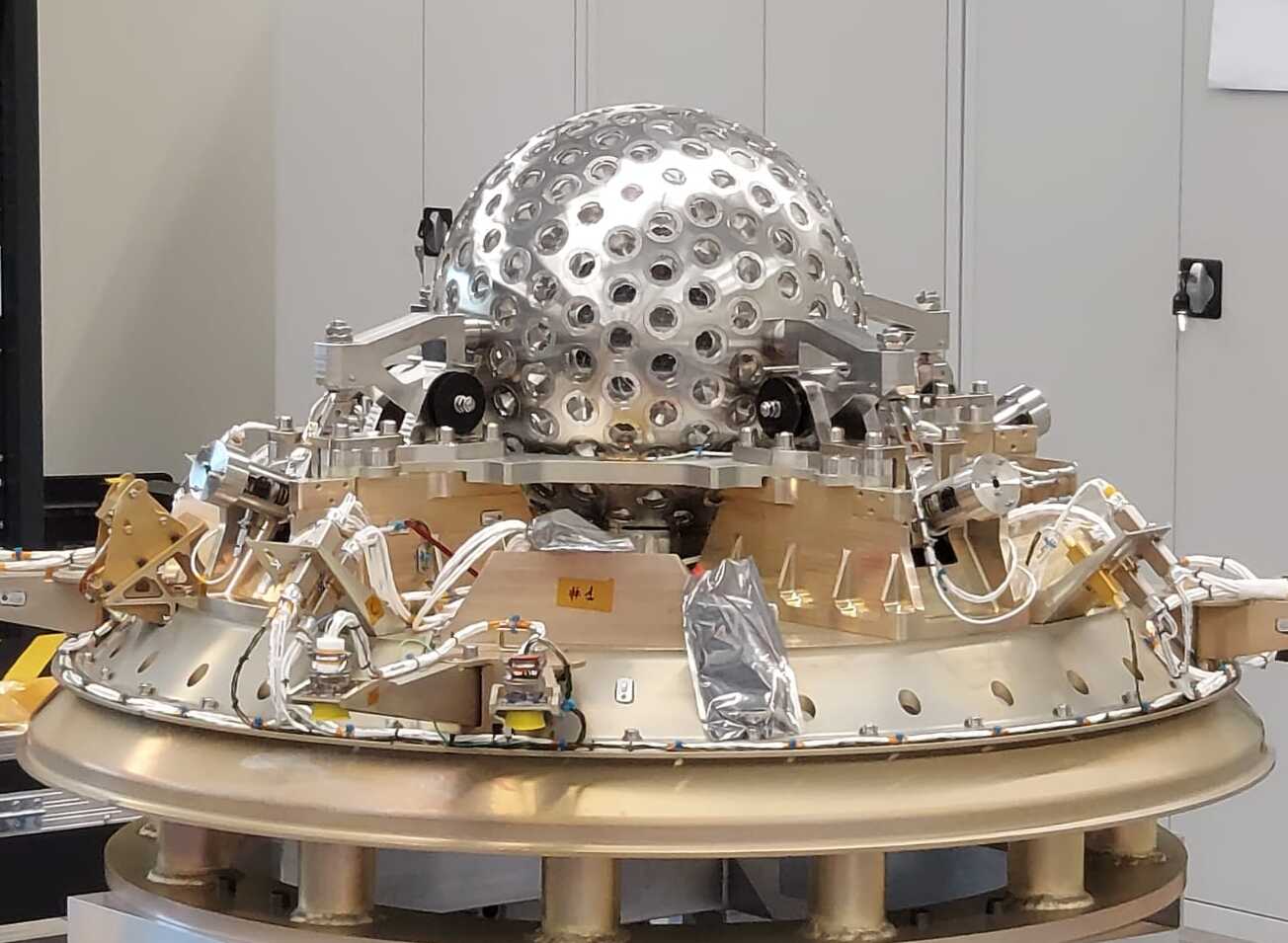
LARES-2 and LAGEOS are geodetic satellites. Their surfaces are fitted with retroreflectors, which return laser pulses transmitted from ground stations. By measuring how long the light takes to travel to the satellites and back, scientists can determine their distances with exceptional precision.
LARES-2 was specifically designed for measurements of this kind. Although small, the satellite is unusually heavy, weighing nearly 295 kilograms. As a result, its orbit is comparatively little affected by influences such as radiation pressure from the Sun.
The orbital geometry also helps: the inclinations of LARES-2 and LAGEOS add up to almost 180 degrees. When the two orbits are analysed together, many of the much larger disturbances caused by Earth’s gravity field, which is not perfectly spherical, largely cancel out. This makes it easier to isolate the far smaller relativistic signal.
What does GRACE have to do with the Einstein test?
Even with this special satellite configuration, one major challenge remains: Earth’s gravity field affects the orbits of LARES-2 and LAGEOS far more strongly than the frame-dragging effect researchers are trying to measure. The gravity field must therefore be known with extremely high accuracy.
This is where GRACE and GRACE Follow-On come in. Their measurements provide precise information about the structure of Earth’s gravity field and how it changes over time. This information is used to calculate the satellite orbits, helping researchers separate the much larger effects of Earth’s ordinary gravitational field from the tiny relativistic signal.
GRACE therefore does not measure frame-dragging directly. Rather, the missions provide an important part of the information needed to measure the effect reliably using LARES-2 and LAGEOS. That is the surprising connection: the same knowledge of Earth’s gravity field that makes it possible to monitor changes in water storage also helps scientists test a prediction of Einstein’s theory of relativity.
A result with just 0.2% relative uncertainty
For the study, the research team analysed around 200,000 laser-ranging observations of LARES-2 and LAGEOS collected over 1,050 days, from July 2022 to June 2025. The result agrees very closely with the prediction of general relativity. The relative uncertainty is only about 0.2%, representing an approximately tenfold improvement over previous tests in the Solar System.
One of the greatest challenges came from the tides. The Moon and Sun not only move water around the oceans but also deform the solid Earth slightly. This, in turn, changes the gravity field and affects the satellites’ orbits.
Of particular importance is the so-called K1 tide, a specific tidal oscillation that repeats approximately once a day. Its effect on the satellites’ orbital planes, however, varies over a much longer period of around 1,050 days. It can therefore mask the slowly accumulating frame-dragging signal. Because the timing and pattern of this tidal signal are very well known, its influence could be identified and removed from the analysis. At the same time, the study provided new information about how accurately this tide has been modelled.
From observing the Earth system to fundamental physics
The study shows how closely different areas of satellite geodesy are connected. Highly accurate knowledge of Earth’s gravity field helps us understand changes in groundwater, ice and other water stores. The same information is also essential when satellite orbits need to be calculated with the greatest possible precision.
At GFZ, this connection extends from observation to analysis. The satellite laser-ranging station in Potsdam contributes high-precision observations of LAGEOS and LARES-2 to the global data set. GFZ’s orbit-determination software EPOS-OC was also used for parts of the orbital analysis in the Nature study.
Satellite geodesy therefore now takes us from the water cycle to spacetime: measurements that reveal changes in mass and water around our planet also help us test fundamental properties of gravity.
Original Study
Ciufolini I, Paolozzi A, Pavlis EC, Ries JC, Paris C, Ortore E, Matzner R, Kuzmicz-Cieslak M, Deka D, Pavlis DE, Schreiner P, Ni WT, Penrose R, Gurzadyan V (2026) LARES-2 satellite measures frame-dragging effect around the Earth. Nature 655, 332–335 (2026). DOI: 10.1038/s41586-026-10715-0