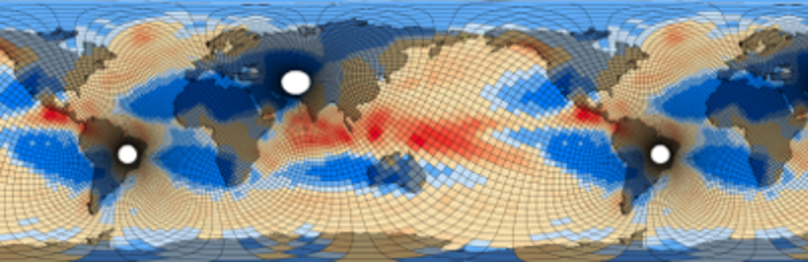
GFZ section 1.3 „Earth system modelling“ routinely operates numerical models of ocean dynamics and continental water storage to provide quasi-real time products of gravity field changes, Earth rotation excitation, and Earth surface deformations. The models are forced with 3-hourly atmospheric data from the European Centre for Medium-Range Weather Forecasts (ECMWF). The geodetic products are updated daily for the last day, including also a 6-day forecast. The products are provided to the scientific community via a GFZ-hosted data portal to analyze and forecast Earth rotation variation, to process GRACE / GRACE-FO observed gravity filed changes, and to reduce elastic Earth surface deformations due to water mass loads from geodetic observations at monitoring sites detached to the Earth surface.
Dr. Robert Dill, GFZ
Operational Processing System (OPS)
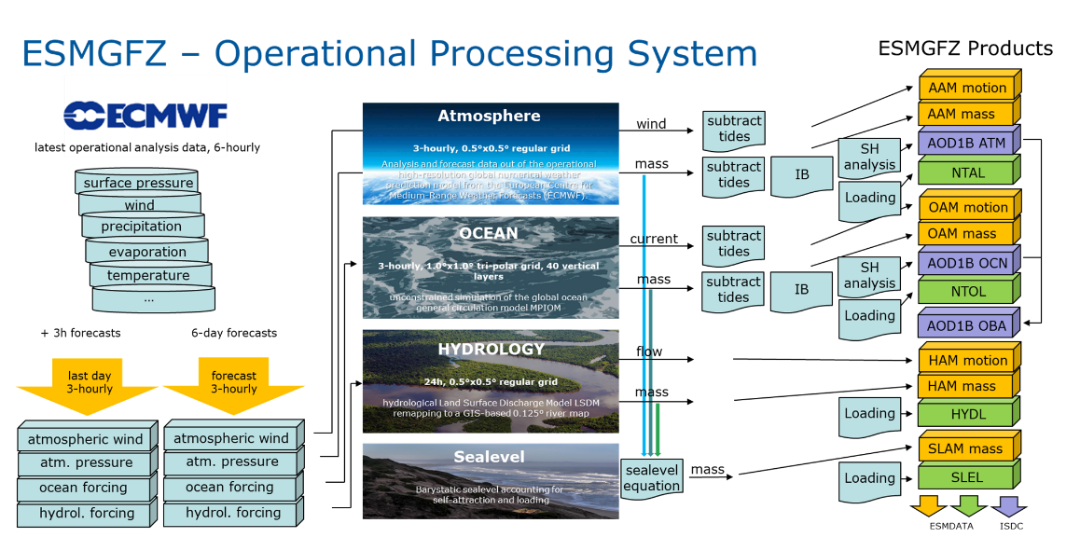
Every day, all necessary processing steps are performed time-controlled by the so-called „Operational Processing System (OPS)“ (Fig. 1). As soon as new atmospheric forcing data is available at ECMWF, the daily atmospheric analysis and forecast data are retrieved from the ECMWF database, compiled to 3-hourly forcing data and transferred to GFZ. This meteorological input dataset, e.g. atmospheric surface pressure, wind, precipitation and temperature consistently forces the Max-Planck ocean model MPIOM (Jungclaus et al., 2013) and the hydrological Land Surface Discharge Modell LSDM (Dill, 2008) to simulate large-scale water redistributions caused by ocean currents, terrestrial water storage in rivers and lakes, snow accumulation, and soil moisture in the Earth’s subsystems with high temporal and spatial resolution.
As soon as new atmospheric forcing data is available at ECMWF, the daily atmospheric analysis and forecast data are retrieved from the ECMWF database, compiled to 3-hourly forcing data and transferred to GFZ. This meteorological input dataset, e.g. atmospheric surface pressure, wind, precipitation and temperature consistently forces the Max-Planck ocean model MPIOM (Jungclaus et al., 2013) and the hydrological Land Surface Discharge Modell LSDM (Dill, 2008) to simulate large-scale water redistributions caused by ocean currents, terrestrial water storage in rivers and lakes, snow accumulation, and soil moisture in the Earth’s subsystems with high temporal and spatial resolution.
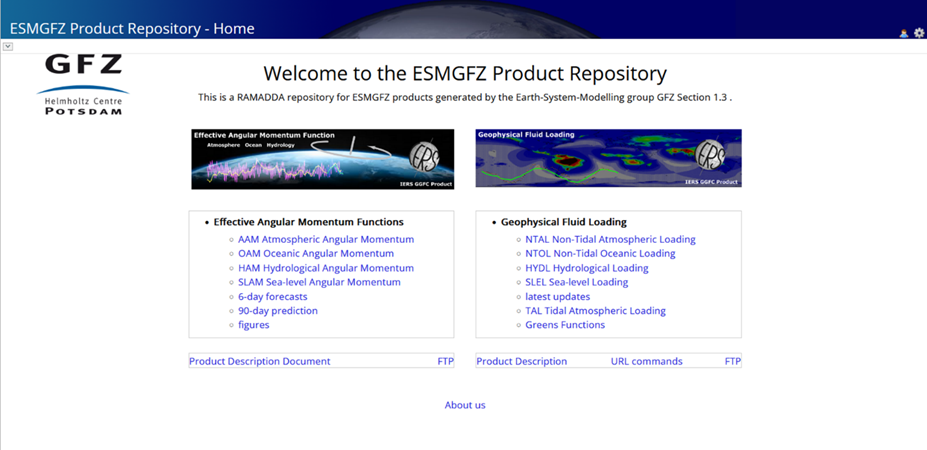
In order to ensure that the sum of all independently simulated model masses from atmosphere, ocean, and land keeps constant, an additional mass correction is introduced as sea-level variation. The applied sea-level change considers the effects of self-gravitation and mass load. All derived products start at 1st of January 1975 and are updated daily until 11 UTC (Universal Coordinated Time, 12 CET Central European Time in Berlin) for all time steps of the past day. The products are made publicly available via www.gfz-potsdam.de/en/esmdata. A RAMADDA-server allows the scientific community to retrieve global yearly data products as well as to select data subsets for individual time series at specific geodetic monitoring site like GNSS or SLR stations (Fig. 2).
Hereinafter, the three most important products will be presented:
Atmospheric Ocean-Dealiasing Level-1B product (AOD1B)
In order to generate global maps of gravity field and water storage variations from the sensor data of the satellite missions GRACE and GRACE-FO, it is mandatory to know in advance high-frequency non-periodic mass variations that are not detectable by the satellite observations themselves. Since 2002, GFZ simulates those signals by realistically forced ocean and hydrology model runs. Those background models results are provided as so-called Atmosphere-Ocean De-aliasing Level-1B (AOD1B) product for all processing centers of the GRACE missions. (Shihora et al., 2022).
Earth rotation excitation functions
Non-periodic Earth rotation variations are mainly caused by mass redistributions in the Earth subsystems of atmosphere, ocean, and terrestrial water storage. From those mass redistributions, that can be predicted very well by numerical models, one can calculate changes in polar motion and the length-of-day. GFZ provides Earth rotation excitation functions with outstanding forecast accuracies used for deep space pointing and operational orbit determinations, e.g. from the European Space Agency ESA (Kehm et al., 2023). Predictions of Earth orientation parameters are also necessary for the secure satellite operation of the GRACE missions.
Elastic Earth surface deformations due to mass loads
Under the variable load of water masses (atmospheric surface pressure, ocean bottom pressure, and terrestrial water storage) the Earth lithosphere reacts with elastic deformations that can displace geodetic instruments and observatories by several millimeters. In order to use geometric measurements of GNSS and SLR, e.g. for the precise orbit determination of the GRACE satellites, the observation data has to be corrected for station motions due to Earth surface deformations. GFZ calculates those vertical and horizontal displacements in two different terrestrial reference frames (origin in Earth’s center of mass, origin in Earth’s center of figure) (Dill und Dobslaw, 2013).
References
Documentation on the MPIOM ocean model (Jungclaus et al., 2013): Jungclaus J. H., Fischer N., Haak H., Lohmann K., Marotzke J., Matei D., Mikolajewicz U., Notz D., Von Storch J. S. (2013): Characteristics of the ocean simulations in the Max Planck Institute Ocean Model (MPIOM) the ocean component of the MPI-Earth system model, Journal of Advances in Modeling Earth Systems, Vol. 5, No. 2, 422—446.
Documentation on the LSDM land surface model (Dill, 2008): Dill, R. (2008): Hydrological model LSDM for operational Earth rotation and gravity field variations, Scientific Technical Report, 08/09, GFZ, Potsdam, DOI:10.2312/GFZ.b103-08095.
Technical article on the atmosphere-ocean dealiasing product AOD1B (Shihora et al, 2022): Shihora, L., Dahle, C., Balidakis, K., Dobslaw, H., Dill, R. (2022): Non-Tidal Background Modelling for Satellite Gravimetry based on operational ECWMF and ERA5 Reanalysis Data: AOD1B RL07. - Journal of Geophysical Research: Solid Earth, 127, 8, e2022JB024360. https://doi.org/10.1029/2022JB024360
Technical article on the prediction of earth orientation changes at ESA (Kehm et al., 2023): Kehm, A., Hellmers, H., Bloßfeld, M., Dill, R., Angermann, D., Seitz, F., Hugentobler, U., Dobslaw, H., Thomas, M., Thaller, D., Böhm, J., Schönemann, E., Mayer, V., Springer, T., Otten, M., Bruni, S., Enderle, W. (2023): Combination strategy for consistent final, rapid and predicted Earth rotation parameters. - Journal of Geodesy, 97, 3.https://doi.org/10.1007/s00190-022-01695-w.
Technical article on elastic load deformations of the lithosphere (Dill and Dobslaw, 2013): Dill, R., Dobslaw, H. (2013): Numerical simulations of global-scale high-resolution hydrological crustal deformations. - Journal of Geophysical Research, 118, 9, 5008-5017. https://doi.org/10.1002/jgrb.50353.