Drawing on the GRACE and GRACE-FO satellite missions, GFZ now delivers operational data on two essential climate variables to the Copernicus Climate Change Service – terrestrial water storage and, for the first time on global scale, groundwater.
Authors
Andreas Güntner1,2, Julian Haas1, Eva Boergens1, Feifei Cao8, Christoph Dahle1, Henryk Dobslaw1, Inés Dussaillant7, Wouter Dorigo5, Annette Eicker1,9, Adrian Jäggi6, Miriam Kosmale4, Johanna Lems5, Kari Luojus4, Ulrich Meyer6, Wolfgang Preimersberger5, Ehsan Sharifi3,1, Michael Zemp7
1 GFZ Helmholtz Centre for Geosciences, Potsdam, 14473, Germany, 2 University of Potsdam, Institute of Environmental Science and Geography, Potsdam, 14476, Germany,
3 Institute of Meteorology and Climate Research-Troposphere Research (IMK-TRO), Karlsruhe Institute of Technology (KIT), Karlsruhe, 76131, Germany, 4 Finnish Meteorological Institute, FMI, Arctic Space Center, Helsinki, 00560, Finland, 5 TU Wien, Department of Geodesy and Geoinformation, Vienna, 1040, Austria, 6 University Bern, Astronomical Institute, Bern, 3012, Switzerland, 7 Department of Geography, University of Zurich, Zurich, 8057, Switzerland, 8 International Groundwater Resources Assessment Centre IGRAC, Delft, Netherlands, 9 HafenCity University Hamburg, Chair of Geodesy and Adjustment Theory, Hamburg, Germany
Summary
How much water is stored in the Earth’s soils, lakes, glaciers and aquifers – and how is this amount changing under climate change? This can be measured from space: the satellites of the GRACE and GRACE-FO missions register fluctuations in the Earth’s gravity field and, after extensive processing, reveal how water moves across the continents, where it is lost and where it accumulates. Based on these unique measurements, the GFZ Helmholtz Centre for Geosciences has launched a new operational data service for the European Union’s Copernicus ClimateIn contrast to weather, which refers to daily or very short-term events, climate refers to an average condition in the atmosphere over a longer period of 30 to 40 years. All processes such as average temperature, precipitation, wind direction, wind s... Change Service (C3S). Since April 2026, global data on changes in terrestrial water storage have been available on C3S, and since October 2026 data on changes in groundwater as well. These two variables are among the so-called essential climate variables defined by the Global ClimateIn contrast to weather, which refers to daily or very short-term events, climate refers to an average condition in the atmosphere over a longer period of 30 to 40 years. All processes such as average temperature, precipitation, wind direction, wind s... Observing System (GCOS). They are an important basis for tracking how the Earth’s climate is evolving and taking targeted measures to adapt to climate change.
From GRACE via G3P to C3S – GFZ’s contribution
In November 2024, the GFZ Helmholtz Centre for Geosciences was commissioned to develop data products on the essential climate variables (ECVs) “Terrestrial Water Storage” and “Groundwater” and to bring them into the Copernicus ClimateIn contrast to weather, which refers to daily or very short-term events, climate refers to an average condition in the atmosphere over a longer period of 30 to 40 years. All processes such as average temperature, precipitation, wind direction, wind s... Change Service (C3S). C3S is part of the EU’s Copernicus Earth observation programme. The GFZ now produces both data sets operationally: “Terrestrial Water Storage Anomaly (TWSA)” since April 2026 and, just recently, since October 2026, “Groundwater Storage Change (GWSC)”.
The new data service is led by GFZ Section 4.4 “Hydrology”, supported by Sections 1.2 “Global Geomonitoring and Gravity Field” and 1.3 “Earth System Modelling”. “Establishing an ECV service on this important European platform marks a high point in the GFZ’s decades of commitment to satellite gravimetry and its hydrological applications,” says Prof Dr Andreas Güntner, working group leader and coordinator of the “Global Gravity-based Groundwater Product (G3P)” project, which was led by the HydrologyThe science of the water cycle. Hydrology analyses the temporal and spatial distribution of water, its properties and its interactions with the environment. The following sciences are related disciplines or sub-disciplines of hydrology, depending on ... Section. G3P produced the prototype for GWSC and laid the foundation for transferring both data products to C3S. “The data service allows us to help the public understand current climate conditions. In the WMO report ‘State of the Global ClimateIn contrast to weather, which refers to daily or very short-term events, climate refers to an average condition in the atmosphere over a longer period of 30 to 40 years. All processes such as average temperature, precipitation, wind direction, wind s...’, for example, we use it to show how climate variability and climate change affect the water cycle and global water resources. This reinforces the GFZ’s role as the leading authority on these issues for politics, business and science in Europe,” adds Dr Julian Haas, project manager of the new ECV service and scientist in the HydrologyThe science of the water cycle. Hydrology analyses the temporal and spatial distribution of water, its properties and its interactions with the environment. The following sciences are related disciplines or sub-disciplines of hydrology, depending on ... Section.
Satellites that weigh water – the path to the TWSA data product
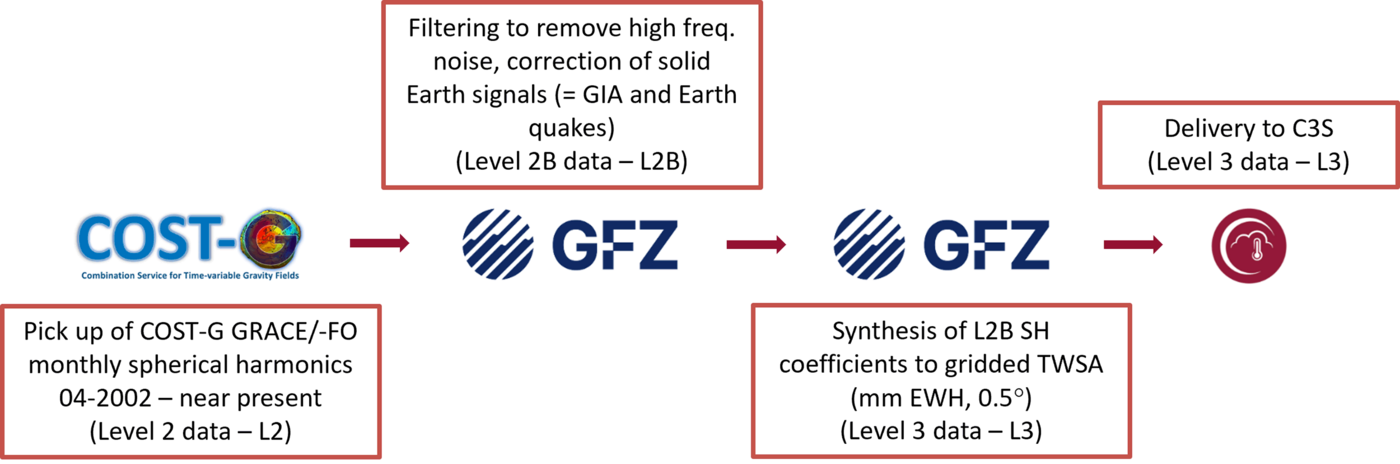
The data service on C3S would not be possible without the German-American satellite missions GRACE (2002–2017) and GRACE-FO (since 2018). Both the TWSA and GWSC products are based on the gravity field data recorded by the satellites, which the GFZ and other analysis centres then process. To calculate the change in terrestrial water storage, the processing first removes interfering influences and any signals that do not originate from water storage. The TWSA product on C3S is based on the mature and widely used GRACE/FO combination solution from the International Combination Service for Time-variable GravityGravity is also known as the force of gravity or mass attraction. Gravity is the force that two or more bodies exert on each other due to their mass. The best-known gravitational force is the Earth's gravitational pull. It causes bodies on earth to f... Fields (COST-G), a long-standing partner of the GFZ. The results are provided on C3S as monthly global data sets on a 0.5-degree grid (approximately 50 kilometres at the equator), together with comprehensive documentation and metadata. They are updated every six months (see Figure 2 in the slider above). Only this long and almost gap-free time series of observations from GRACE and GRACE-FO reveals long-term trends and large-scale relationships. Continuing satellite gravimetry as an observation system over the coming decades is therefore invaluable for climate research.
From gravity field to groundwater – the path to the GWSC data product
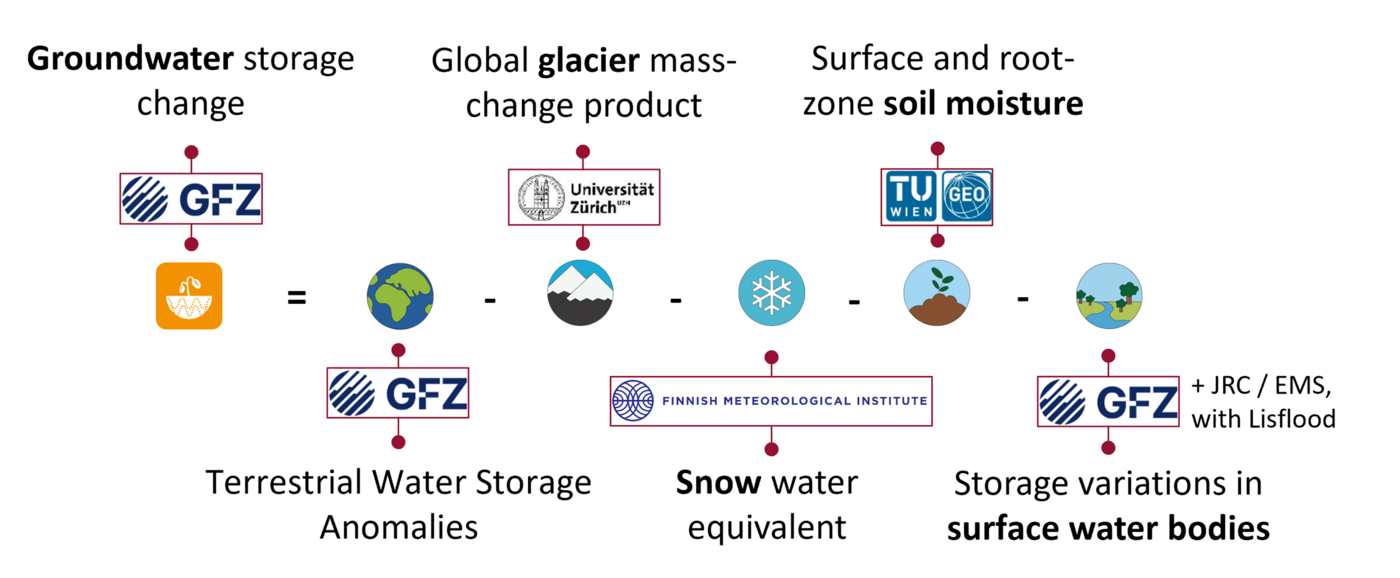
Groundwater cannot be observed directly from space, and measurements in individual wells on the ground do not provide area-wide information either. But GRACE/FO offers a way forward here, too. The trick behind GWSC is that the total change in terrestrial water storage recorded by GRACE/FO is the sum of the changes in the five largest water storage components of the terrestrial water cycle: glaciers, snow, soil moisture, surface water and groundwater itself. For GWSC, the storage changes of the other four components are subtracted from TWSA, so that the change in groundwater storage remains (see Figure 3 in the slider above). International partners supply global data on these components from their Copernicus portfolios, based on remote sensing and computer models: soil moisture from TU Wien, glaciers from the University of Zurich, snow from the Finnish Meteorological Institute (FMI) and surface water from the EU’s Joint Research Centre (JRC). The method developed in the G3P project was further refined for Copernicus and largely automated. Details of the approach, the data sources and the processing are given in Güntner et al. (2026). GWSC is updated on C3S roughly once a year, because each processing run requires a complete global glacier product covering the full year.
What the data show – application and use
The new data sets close gaps in Earth observation and open up analyses that were not possible before. For example, using TWSA data, the GFZ was able to show how the water deficit in Germany and Europe has worsened in recent years (to news on gfz.de ). With GWSC, groundwater trends can now be compared globally for the first time, as shown by Hohensinn et al. (2026).
Background: GCOS and essential climate variables
The Global ClimateIn contrast to weather, which refers to daily or very short-term events, climate refers to an average condition in the atmosphere over a longer period of 30 to 40 years. All processes such as average temperature, precipitation, wind direction, wind s... Observing System (GCOS) was established in 1992 by the World Meteorological Organization (WMO) and the United Nations, among others. It works to ensure that climate-relevant observations are collected worldwide to a high standard and are freely available. GCOS does not produce its own products, but supports the collection and provision of comprehensive and continuous data series on the entire climate system. It also defines the corresponding requirements for observation systems and measurement networks.
GCOS has currently defined 55 essential climate variables (ECVs) for the atmosphere, land and ocean domains, such as precipitation, greenhouse gas concentrations, evaporation, land and ocean surface temperatures, sea level and the oxygen content of the oceans. The ECVs in the land domain also include “Groundwater” and “Terrestrial Water Storage” (TWS), which GCOS added as a new ECV in 2022. ECV data sets provide the empirical evidence needed to understand climate change, assess risks and attribute climate phenomena to their causes, and are therefore a key basis for the work of the United Nations Framework Convention on ClimateIn contrast to weather, which refers to daily or very short-term events, climate refers to an average condition in the atmosphere over a longer period of 30 to 40 years. All processes such as average temperature, precipitation, wind direction, wind s... Change (UNFCCC) and the IPCCThe Intergovernmental Panel on Climate Change - IPCC for short - is an intergovernmental committee on climate change. The IPCC is also known as the Intergovernmental Panel on Climate Change. It is a scientific body that collates the current status of... (source: https://gcos.wmo.int/site/global-climate-observing-system-gcos/essential-climate-variables/about-essential-climate-variables).
Further links
References
Paper about G3P: Güntner, A., Sharifi, E., Haas, J., Boergens, E., Cao, F., Dahle, C., Darbeheshti, N., Dobslaw, H., Dussaillant, I., Dorigo, W., Flechtner, F., Jäggi, A., Kosmale, M., Lasser, M., Luojus, K., Meyer, U., Pasik, A., Preimesberger, W., Ruz Vargas, C., and Zemp, M.: The Global GravityGravity is also known as the force of gravity or mass attraction. Gravity is the force that two or more bodies exert on each other due to their mass. The best-known gravitational force is the Earth's gravitational pull. It causes bodies on earth to f...-based Groundwater Product (G3P), Earth Syst. Sci. Data, 18, 7787–7816, https://doi.org/10.5194/essd-18-7787-2026, 2026.
Paper about global trends of ground water: Hohensinn, R., Gou, J., Meyer, U., Humphrey, V., Dorigo, W., Boergens, E., Soja, B., Gruber, A., Jensen, L., Eicker, A., Rast, M., and Güntner, A.: Water storage trends derived from the GRACE/-FO global gravity-based groundwater product (G3P), EGUsphere [preprint], https://doi.org/10.5194/egusphere-2026-975, 2026.