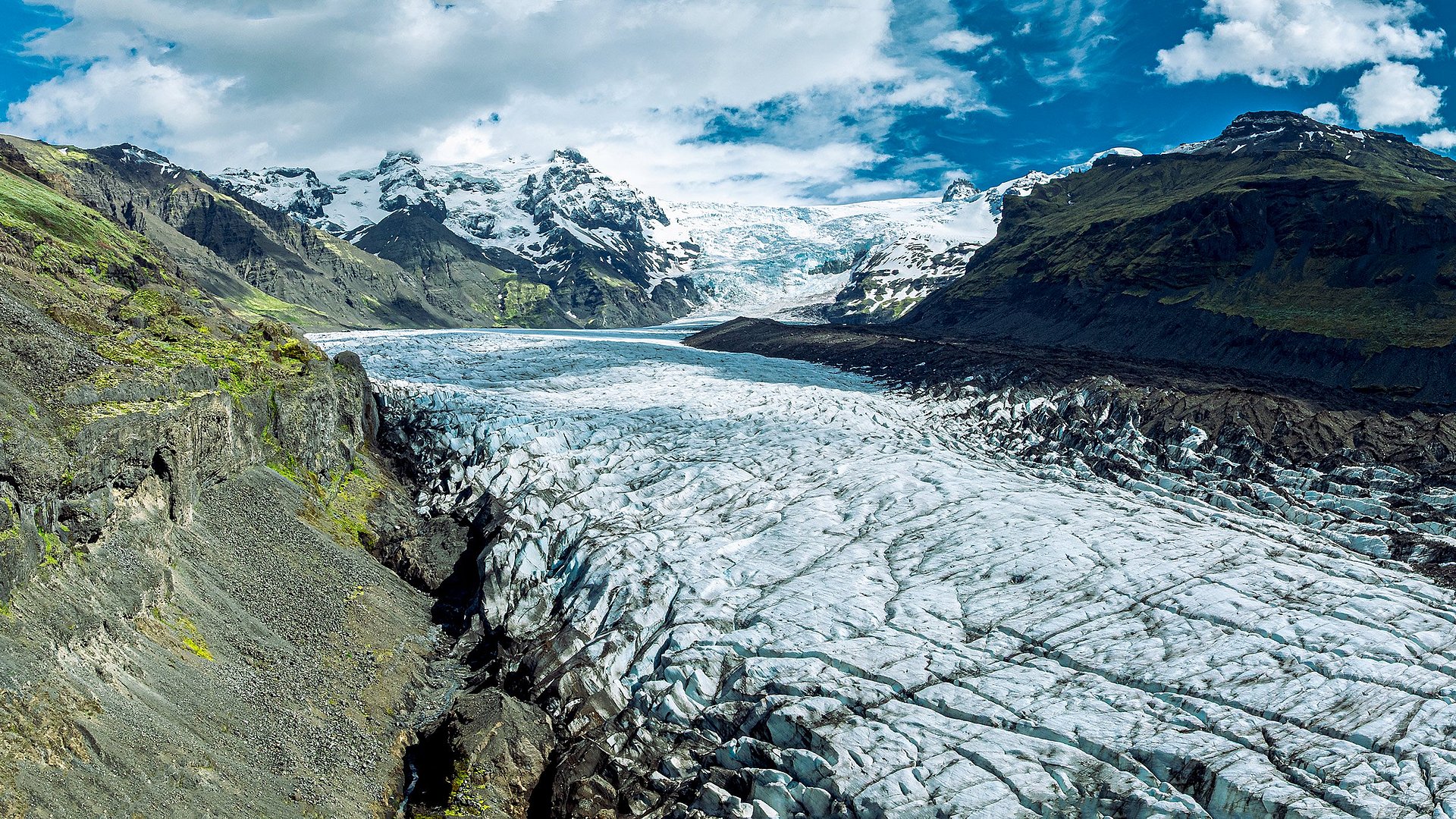
Glaciers in Alaska and Iceland are melting faster than previously thought. For years, satellites have underestimated the rate of ice loss. The reason for this lies deep within the Earth: the mantle beneath both regions is unusually hot and nearly fluid. Consequently, the land is rising rapidly, 'masking' part of the melting signal. Once this effect is factored out, it emerges that the glaciers are losing around ten gigatonnes more ice per year than was previously thought. This is causing sea levels to rise by a further 0.03 millimetres per year, a consequence that had not been anticipated.
Text: Dr. Ingo Sasgen, Alfred Wegener Institute for Polar and Marine Research & Dr. Volker Klemann, GFZ Helmholtz Centre for Geosciences
Satellite measurements had previously suggested that the glaciers in Alaska and Iceland were losing ice at a significant rate, but this has now been found to be even higher. Reason is an often-overlooked effect: in both regions, the ground is rising much more quickly than was previously thought. This rapid land uplift masks the gravity field signal measured by satellites, thereby obscuring part of the actual ice loss. Taking into account the processes taking place inside the Earth reveals that the ice mass balance for both regions is around 10 gigatonnes more negative per year, which increases the contribution of glaciers to global sea-level rise by around four per cent. This information comes from a research team led by the Alfred Wegener Institute, in collaboration with the GFZ Helmholtz Centre for Geosciences, the Universities of Bremen and Augsburg, and the University of Zurich, and was published in the journal Communications Earth & Environment.
Since 2002, the GRACE satellite mission and its successor, GRACE-FO, have been measuring the Earth’s gravitational field with grand accuracy. When glaciers lose mass, the gravitational pull over the region weakens. By detecting these minute changes, it is possible to deduce the ice mass balance of entire mountain regions. Conversely, the Earth reacts to the weight of the glaciers like a modern foam mattress: the ground slowly subsides where ice lies and rises with a delay when it disappears. This is due to the slow return flow of displaced rock material in the Earth’s mantle. Experts refer to this process as glacial isostatic adjustment (GIA). In order to quantify the mass loss, this land uplift must be subtracted from the gravity signal.
Until now, this adjustment was considered a gradual process occurring over millennia. As a minor background signal, it could be easily subtracted from current ice losses. 'This assumption breaks down in Alaska and Iceland,' says Dr Ingo Sasgen, a glaciologist at the Alfred Wegener Institute – Helmholtz Centre for Polar and Marine Research (AWI), and the lead author of the study. 'Beneath both regions, the upper mantle is exceptionally hot and fluid. The land is rising on a timescale of years to decades – in other words, on the same timescale over which the glaciers are currently melting.” The result is that the inflowing mantle material compensates for a much larger proportion of the mass loss at the surface. This makes the glacier retreat appear smaller than it actually is in the satellites’ gravity field signal.
Until now, this adjustment was considered a gradual process occurring over millennia. As a minor background signal, it could be easily subtracted from current ice losses. 'This assumption breaks down in Alaska and Iceland,' says Dr Ingo Sasgen, a glaciologist at the Alfred Wegener Institute – Helmholtz Centre for Polar and Marine Research (AWI), and the lead author of the study. 'Beneath both regions, the upper mantle is exceptionally hot and fluid. The land is rising on a timescale of years to decades – in other words, on the same timescale over which the glaciers are currently melting.” The result is that the inflowing mantle material compensates for a much larger proportion of the mass loss at the surface. This makes the glacier retreat appear smaller than it actually is in the satellites’ gravity field signal.
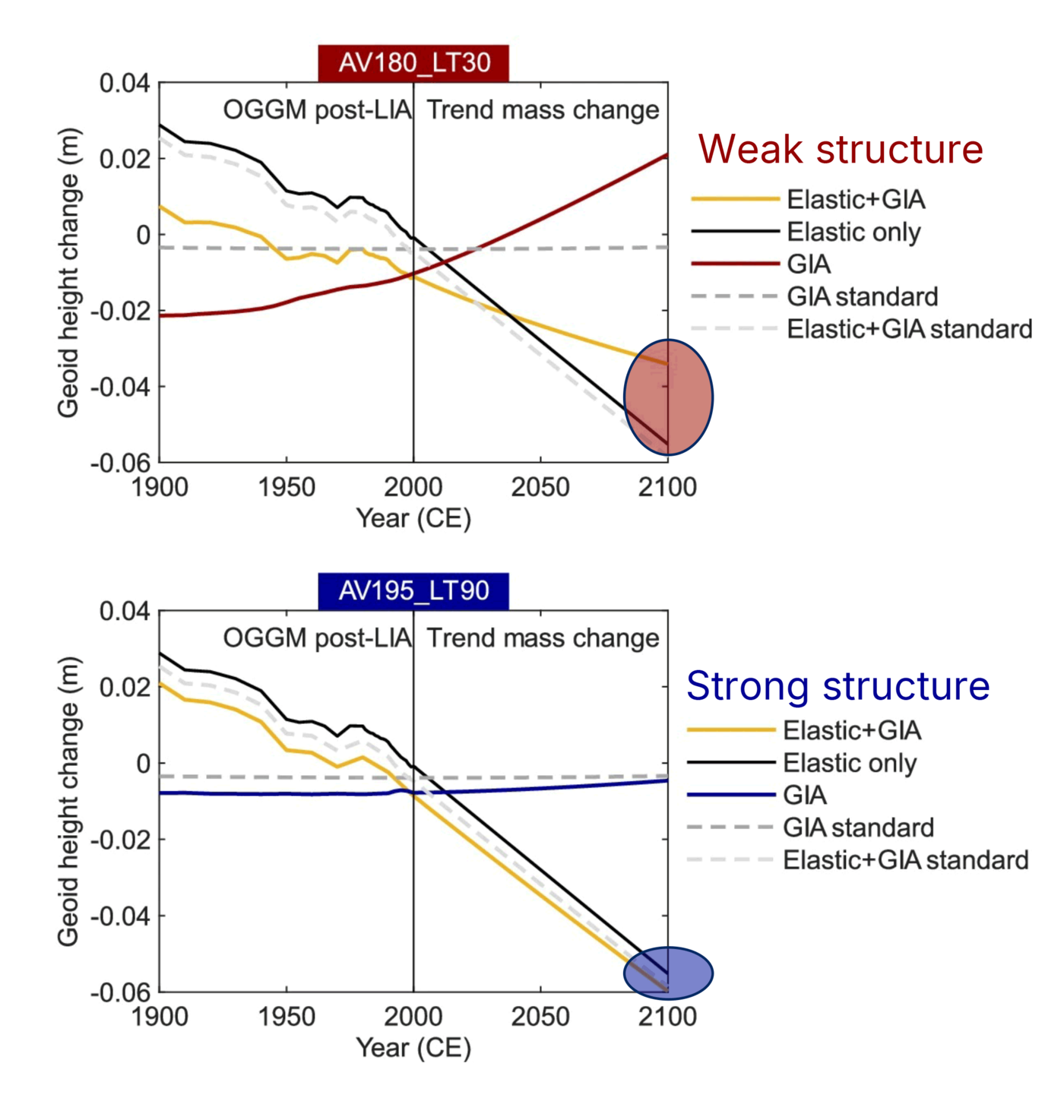
In order to quantify this effect, the team had to look further back in time, to the Little Ice Age in particular, when the glaciers in both regions were at their maximum extent in recent centuries. Dr Anouk Vlug, from the University of Bremen, used the Open Global Glacier Model (OGGM) to reconstruct the development of almost 28,000 glaciers over the past thousand years.
Dr Volker Klemann from the GFZ Helmholtz Centre for Geosciences in Potsdam used the VILMA Earth model to calculate how the subsurface reacts to this loading and unloading for 33 different Earth structures, varying the viscosity of the Earth’s mantle and the thickness of the Earth’s crust. “In the softest models, land uplift is almost balanced out after just a few years,” explains the geophysicist. “This means that the signal from the Earth’s interior can no longer be simply subtracted from today’s ice loss. It is precisely these coupled signals that we have now been able to quantify for the first time.”
Using the model results, the team re-analysed the GRACE/GRACE-FO data from 2002 to 2025. The result: in Alaska, glaciers are losing around 82 gigatonnes of ice per year – about nine per cent more than conventional estimates. In Iceland, ice loss is actually increasing by around a third to approximately 11 gigatonnes per year. The rapid component of land uplift linked to current melting alone accounts for around 7 gigatonnes of annual ice loss in Alaska and 3 gigatonnes in Iceland.
These figures are supported by comparisons with independent methods. Professor Michael Zemp of the University of Zurich highlights the significant discrepancy between satellite gravimetry and elevation model comparisons in Alaska, with gravimetry consistently indicating less ice loss than anticipated. Rapid land uplift now provides a physically plausible explanation for much of this discrepancy. The study is further corroborated by GPS measurements of land uplift, which support the low mantle viscosity derived by the team from seismic data.
The findings have implications that extend far beyond the two regions that were studied. Together, Alaska and Iceland account for around a quarter of global glacier retreat; accordingly, the correction increases the calculated contribution of glaciers to global sea-level rise by around 0.03 millimetres per year. Researchers expect to see similar effects wherever significant ice loss occurs in areas where the Earth's mantle is soft, such as in Patagonia, southeastern Greenland and parts of West Antarctica. “If we want to accurately account for sea-level rise, we can no longer treat the solid Earth as a rigid stage,” emphasises Ingo Sasgen. “It plays an active role – and in some regions it reacts almost as quickly as the ice itself. Future gravity field missions such as MAGIC will benefit if we incorporate this coupling into the analysis from the outset.”
Literature
Ingo Sasgen, Sebastian Cruz Bacca, Volker Klemann, Anouk Vlug, Michael Zemp: Rapid rebound hides glacier mass loss from satellite observations in Alaska and Iceland. Communications Earth & Environment, 7:518 (2026). DOI: 10.1038/s43247-026-03738-y
This text was partially generated by AI.