The report highlights new climatic phenomena that are exacerbating hydrological extremes even further. In Spain and Portugal, for instance, “climate whiplash” combined with a flash drought amplified each other: an unusually wet spring was followed within just a few months by a pronounced drought and forest fires. This rapid shift, together with the extremely fast loss of soil moisture, has fundamentally altered the region’s hazard profile over the long term.
Text: Dr. Julian Haas/GFZ Helmholtz Centre for Geoscience, Albert van Dijk/ Australian National University
In 2025, the global water cycle was shaped by intensifying extremes, rapid shifts between wet and dry conditions, and major events in unexpected places and times of year.
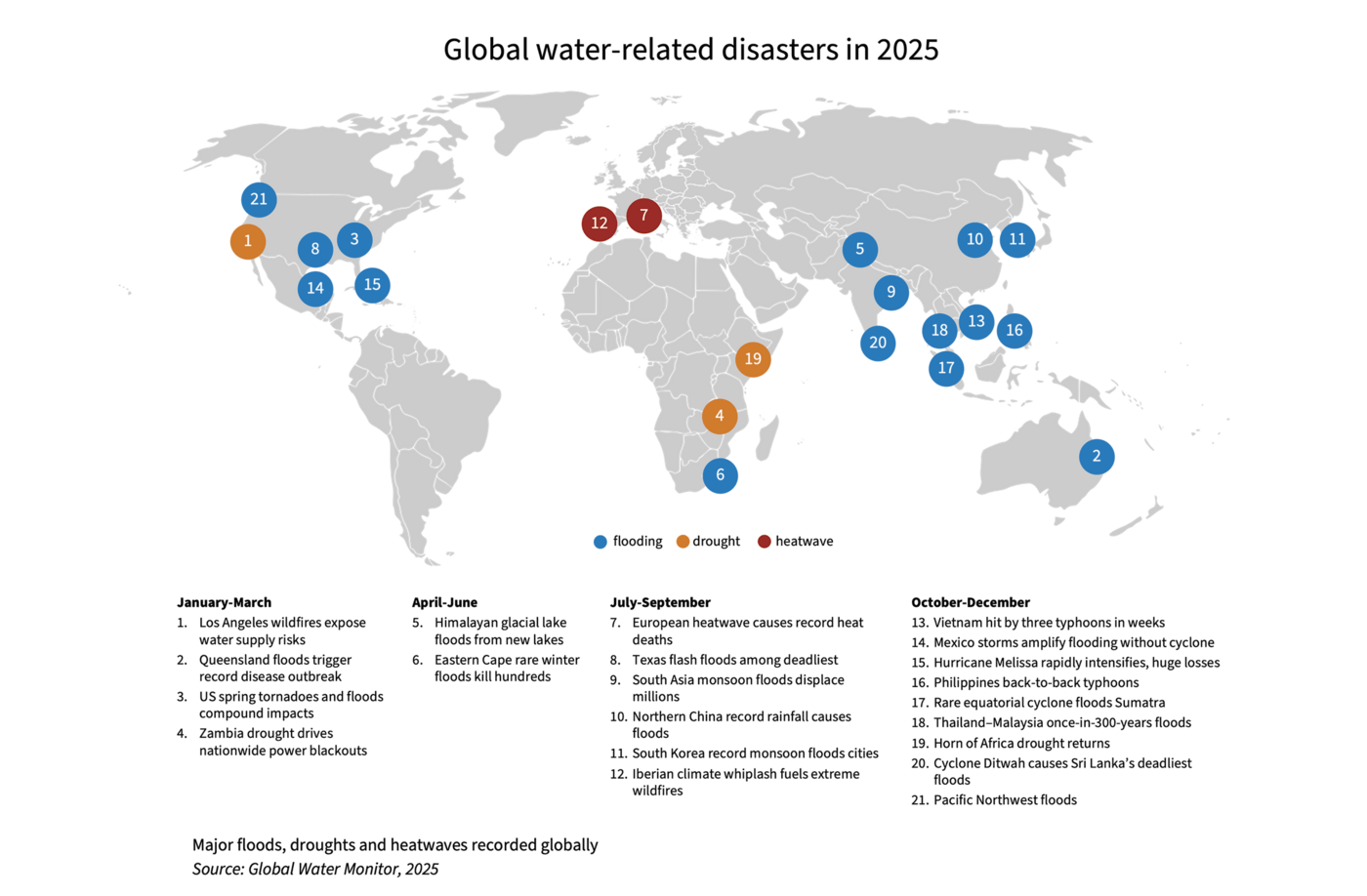
The following world map provides an overview of the most significant flood and drought events of the past year. Alongside newer phenomena such as 'climate whiplash' (the rapid alternation of wet and dry periods) and flash droughts (sudden droughts), there has been a notable increase in extreme flooding in Asia and North America.
Key findings for the year 2025
The 2025 summary report provides the latest information on trends in the water cycle and on major water-related disasters. Some of the key findings include:
- Water-related disasters in 2025 caused nearly 5,000 deaths, displaced around 8 million people, and resulted in economic losses exceeding US$ 360 billion globally.
- Extreme rainfall is intensifying globally, with maximum daily precipitation increasing 2.3% per decade, contributing to floods and landslides.
- The past three years were the hottest on record worldwide, confirming a persistent warming trend.
- Hot days exceeding 35 °C have been increasing by 8.3% per decade, threatening human health, ecosystems, and agricultural systems.
- Climate whiplash amplified disaster impacts, with rapid transitions between wet and dry conditions affecting the same regions in quick succession. In Spain and Portugal, a wet spring was followed by flash drought and severe wildfires within months.
- Flash droughts are emerging as an increasingly distinct hazard, driven by rapid declines in soil moisture and water storage over days to weeks rather than gradual seasonal drying.
- Water-related hazards appeared in unlikely places and at unprecedented frequencies, including an equatorial cyclone affecting Indonesia and unprecedented glacial lake outburst floods in the Hindu Kush Himalaya.
- Risks developing for 2026 include drought building across the Mediterranean, the Horn of Africa, Brazil, and Central Asia, with wet conditions in the Sahel, southern Africa, northern Australia, and much of Asia making flooding more likely.
The above findings indicate mounting pressure on the global water system. Faster hydrological changes and rising temperatures pose an increased risk to people, ecosystems and infrastructure.
Global Water Monitor
The Global Water Monitor Consortium, led by Albert van Dijk of the Australian National University in Canberra, publishes an annual summary of developments in the global water cycle for the previous year. A key objective is to make the most up-to-date data available to the public and decision-makers as early as possible. Adopting this approach means that the report is often the first in a series of global reports (e.g. from the WMO and the EU).
The data used in this report comes from ground-based measuring stations and satellites. These sources provide up-to-date, global information on precipitation, air temperature, humidity, soil and groundwater conditions, total water storage, water availability for vegetation, river runoff, flooding, and lake volumes over the past year. All the data is freely available and can be visualised, examined and downloaded via the Global Water Monitor Data Explorer.
Background: The GFZ and GRACE-FO
The GFZ is one of the official analysis centres for the GRACE and GRACE-FO satellite missions. It processes data collected by the satellites on changes to the Earth's mass to derive information such as changes to total water storage.
The sections hydrology, represented by Dr. Julian Haas and Prof. Andreas Güntner, as well as Earth System Modelling represented by Dr. Eva Boergens are contributing data on total water storage (terrestrial water storage) for the third consecutive time, i.e. for the 2023, 2024 and 2025 reports. Data from the GFZ GravIS platform and the Copernicus Climate Change Service (C3S) on terrestrial water storage anomalies, newly established by the aforementioned colleagues, will be used for this purpose.
Link Tips:
- The main report, reports for individual countries and the global Data Explorer are available at: https://www.globalwater.online/
- Overview of hydrological conditions in 2025 in Germany (PDF)
- Focus: Terrestrial Water Storage (globalwaterstorage)
- to Data Portal GravIS
- to the page: C3S | Data Service for Terrestrial Water Storage & Groundwater