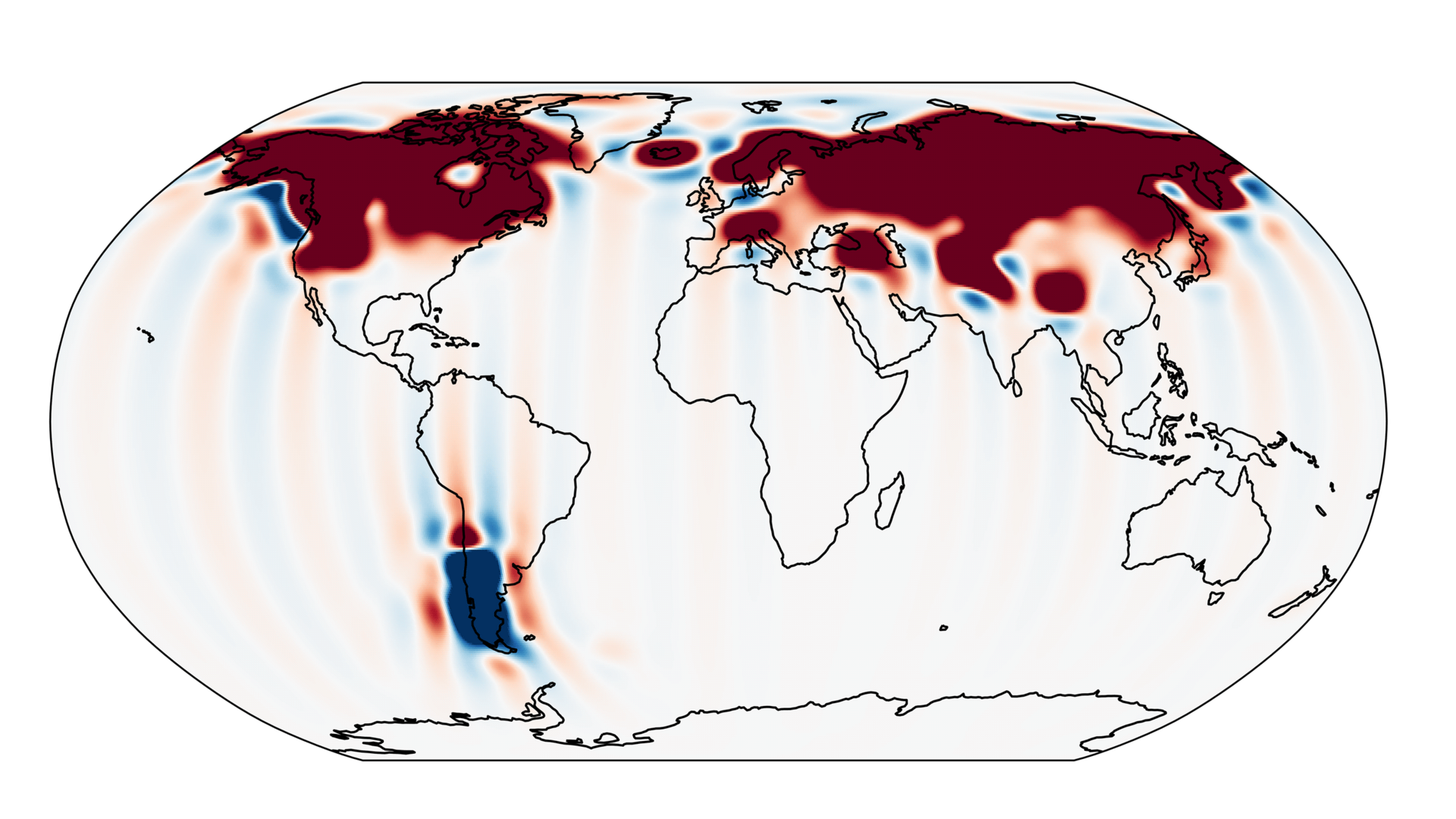
GRACE and GRACE-FO recover Terrestrial Water Storage Anomalies from monthly gravity variations. Groundwater storage anomalies can be estimated as a residual after subtracting other water storage compartments, but only if all input fields share a comparable effective spatial resolution. An isotropic Gaussian kernel with ~250 km filtering width harmonizes input water storage compartments to the smoothed spatial correlation structure of spherical harmonic GRACE-TWSA Level-3 products, whereas spectral decorrelation filters (DDK/VDK) introduce striping artefacts when applied to datasets lacking GRACE-type spatially correlated errors.
Ehsan Sharifi, Karlsruhe Institute of Technology, & Julian Haas, GFZ Helmholtz Centre for Geosciences
The big picture: satellites that weigh water
Since 2002, the GRACE and GRACE-FO missions monitor temporal changes in Earth’s gravity field. Over land, gravity variability is driven mainly by mass redistribution following the terrestrial water cycle. Data products derived from spherical harmonic gravity solutions provide a global record of Terrestrial Water Storage Anomalies (TWSA), i.e., monthly deviations of water mass stored on the continents relative to the long‑term mean of a reference period. To isolate groundwater from TWSA, water storage compartments (WSCs) like root‑zone soil moisture, snow water equivalent, surface water storage, and glacier mass change can be subtracted, as implemented in global water‑budget residual products such as the Global Gravity-based Groundwater Product (G3P).
Why filtering is essential and why the filter type matters
To suppress noise in GRACE observations, which are represented as spherical harmonics, filters like the Deterministic Decorrelation Kernel (DDK) and its time‑variable variant (VDK), are applied. These filters are specifically designed to work with GRACE’s correlated gravity‑harmonic error structure. Their use requires a normal equation matrix or spatial covariance model for error correlations. WSC datasets based on observations or models do not have these GRACE‑typical features. Applying DDK/VDK filters to such data can introduce artificial errors, commonly referred to as striping, confounding residual groundwater anomaly estimates.
What was tested and what emerged
Gridded datasets of WSC anomalies expressed in equivalent water height (mm) were aggregated to a common 0.5° grid. Seasonal cycles and long‑term trends were removed at each grid cell so that climate signals would not dominate the following spatial autocorrelation analyses. Empirical spatial autocorrelation functions were computed for each month and temporally averaged. By this, it is possible to quantify the similarity of anomaly values between grid cells at distances shorter than typical seasonal climate-zone similarity.
Three principal results emerged from this:
- As expected, after conversion of the WSCs to spherical harmonics and applying the spectral DDK/VDK filters, non‑physical north-south stripes were introduced. As mentioned above, this occurs because DDK/VDK filters are tailored to correlated gravity-harmonic errors and are not appropriate for data sets where noise is largely uncorrelated in space.
- Isotropic Gaussian kernels applied in the grid space suppressed short‑scale variability without introducing stripes.
- By minimizing the Root‑Mean‑Square Difference between the spatial autocorrelation decay curves of the WSCs and of GRACE‑based TWSA an optimal Gaussian filter width of 250 km (in the significant distance bins of 0 to 1100 km) was identified. The derived direction‑free anomaly fields are considered most compatible for the groundwater subtraction approach.
Why this matters for groundwater isolation
To sum it up, groundwater storage anomalies derived by the G3P residual approach reflect all spatial processing details applied upstream. When WSC datasets are much “sharper” than spatially smoothed GRACE-based TWSA, this small-scale variability can propagate into the residual and lead to false groundwater signals. Similarly, applying spectral anisotropic decorrelation filters designed for removing GRACE-type correlated errors to datasets without those features introduces stripes, also leading to misinterpretations.
Applying isotropic Gaussian smoothing in the gridded domain, with a width near 250 km, brings the gridded WSC datasets to a spatial correlation decay scale comparable to spherical-harmonic GRACE Level-3 products while avoiding striping. This preserves the dominant large-scale hydrological structure, improving the physical basis for residual groundwater inference at a global scale.
A side note on computational efficiency: The filtering sequence was evaluated in two configurations: a) aggregating all WSC datasets to the target grid prior to applying isotropic smoothing, and b) filtering each WSC at its native higher spatial resolution (e.g. 0.25°) before aggregation. Both workflows produced nearly identical spatial fields and global autocorrelation decay characteristics, while configuration a) required substantially lower computational effort and run time.
Practical Takeaways
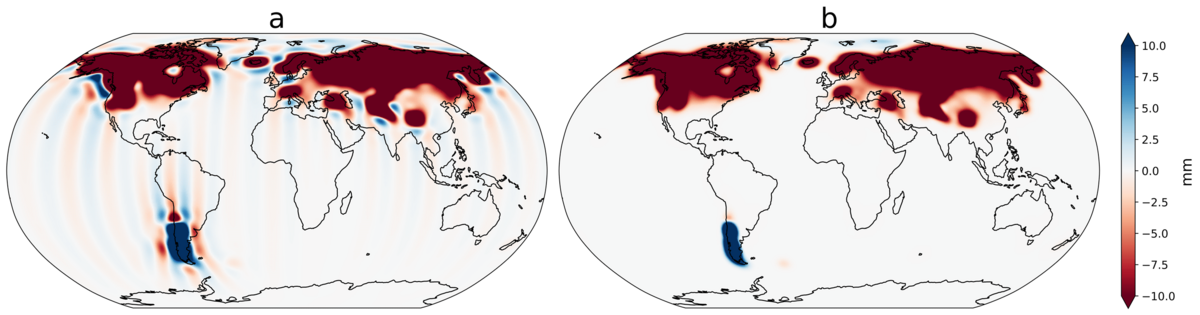
- The DDK/VDK class of spectral decorrelation filters should not be transferred to gridded hydrological storage anomaly datasets lacking GRACE-type correlated errors because they introduce artificial north-south stripe artefacts.
- Isotropic Gaussian spatial filtering in the gridded domain suppresses short‑scale variability while preserving direction‑free spatial compactness.
- Filter strength should be obtained via spatial autocorrelation matching to GRACE-based TWSA spherical harmonics correlation curves.
- In a global assessment with four water storage compartments, intended for estimating groundwater anomalies from TWSA via a subtraction approach, a Gaussian width of ~250 km most consistently aligns correlation decay over the range of significant spatial similarity (0 to 1100 km distance bins).
- The presented filter width is specific to the here used datasets. If any different dataset is included, be it another TWSA solution, different WSCs or just a longer/shorter record, the correlation analyses would need to be re-done. Get in touch with the authors for help!
References
- Global Gravity-based Groundwater Product G3P
- Gravity Information Sercie GravIS
- Sharifi, E., Haas, J., Boergens, E., Dobslaw, H., Güntner, A. (2025): Technical note: GRACE-compatible filtering of water storage data sets via spatial autocorrelation analysis. - Hydrology and Earth System Sciences, 29, 23, 6985-6998. https://doi.org/10.5194/hess-29-6985-2025