
The GRACE and GRACE-FO satellite missions show a dramatic global increase in the drought-affected areas, particularly in Europe. For Germany, this means a continuing downward trend in water storage. By the end of 2025, the water deficit was around 25 billion tonnes compared to the average since 2002.
Text: Dr. Eva Boergens & Dr. Julian Haas, GFZ Helmholtz Center for Geoscience
The GRACE (Gravity Recovery and ClimateIn contrast to weather, which refers to daily or very short-term events, climate refers to an average condition in the atmosphere over a longer period of 30 to 40 years. All processes such as average temperature, precipitation, wind direction, wind s... Experiment, 2002–2017) and GRACE-FO (GRACE-Follow-On, since 2018) satellite missions enable the monitoring of global water storage at monthly resolution. Now that 24 years of data are available, long-term changes can be analysed.
Extreme trends: Fewer and fewer areas with ‘normal’ water storage
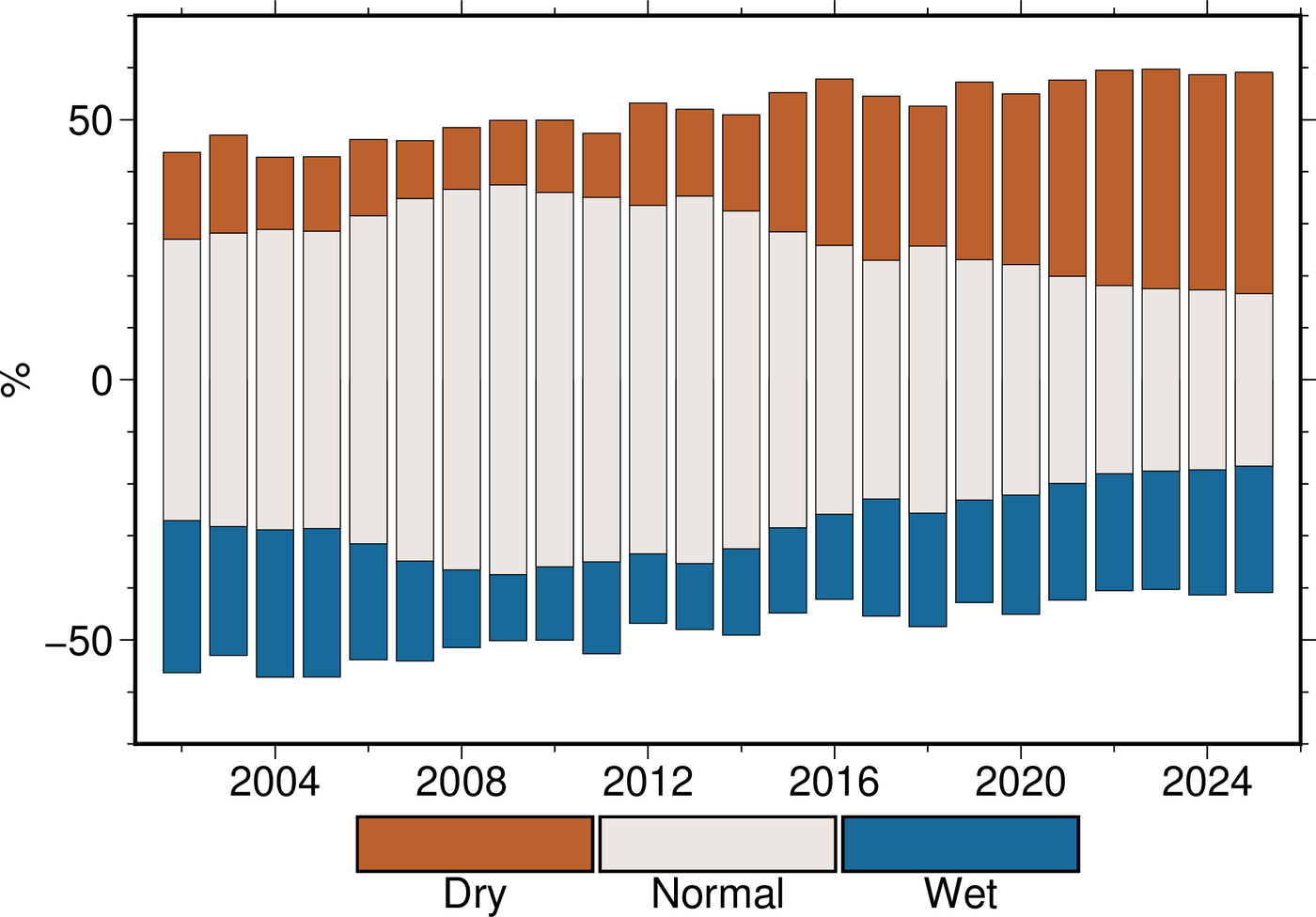
In the figure shown here, the change in water storage is not presented in terms of absolute deviations in millimetres, but rather as a categorisation:
- Dry: water storage was as low as the driest 25% of the remaining observations at the site
- Normal: water storage corresponded to the middle 50% of the observations
- Wet: water storage was as high as the wettest 75–100% of the observations at the site
Presenting the data in categories makes it easier to compare regions with different hydrological regimes and characteristics. For each grid point and month, the state of water storage is compared with the long-term average to determine whether conditions were ‘normal’, ‘dry’ or ‘wet’. Figure 1 shows the proportion of observations in each category for each year.
Globally, extremes in water storage are becoming more common. While 75% of the land area still had normal water storage levels in 2009, this number has fallen to just under a third by 2025. This decline is primarily due to an increase in dry areas, which have grown from 12% in 2009 to nearly 43% in 2025.
In contrast, the area of land classified as wet has remained roughly the same over the last 24 years, returning to a state similar to that seen over 20 years ago.
Regional differences: Africa is the exception, whilst the Arctic and Europe are particularly affected

However, this global overview only provides a general picture and does not take regional differences into account in detail. A more nuanced picture emerges when we examine the 61 continental river basins and how they have developed over the past 24 years. For each of these major river basins and each year, the average of all observations is shown using a colour-coded system: red indicates a water storage shortage and blue indicates a water storage surplus.
Of all the world’s regions, Africa is the only region to record a significant increase in water storage. Australia and Oceania also show a slight increase. In the other regions, however, a decrease can be observed, with the melting of Arctic glaciers standing out in particular. Figure 3 shows that all catchment areas in Europe and the Middle East have experienced a decrease in water storage.
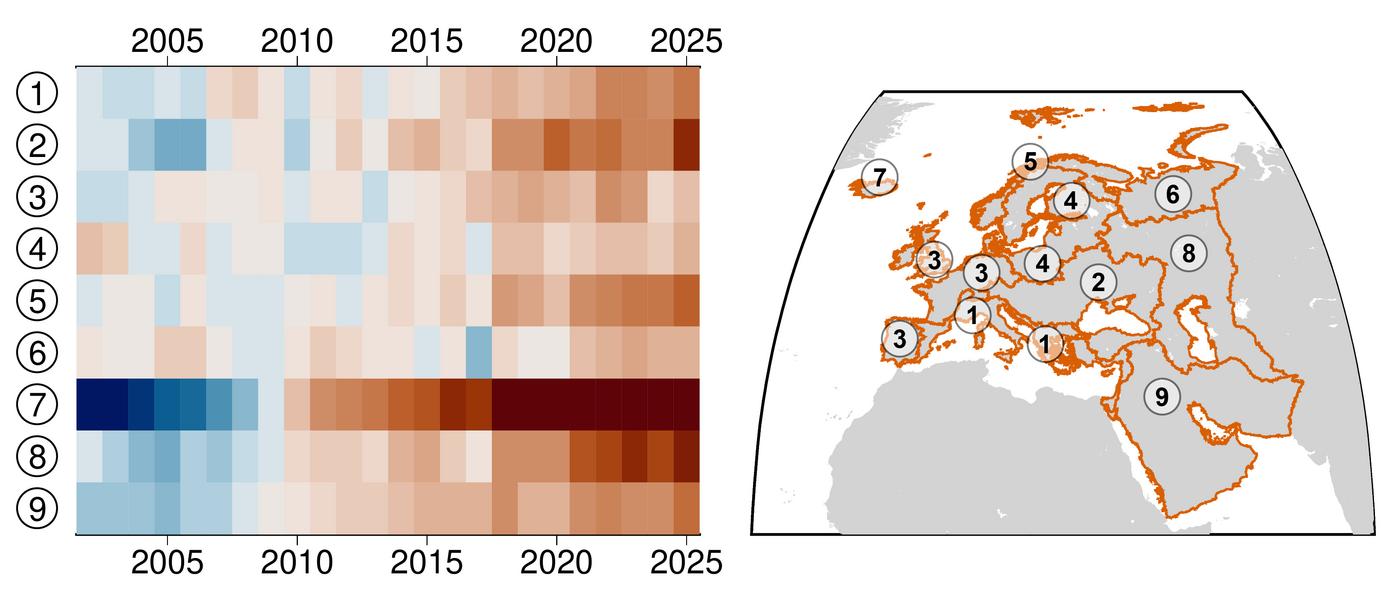
The decline in glacial ice is particularly pronounced in Europe in Iceland (Region 7). Although water storage is decreasing in all regions, the point at which a negative trend becomes apparent varies. Water storage in the Middle East (Region 9) has been declining since 2009, whereas in Western Europe — encompassing most of Germany (Region 3) — a continuous decline has only been observable since around 2014.
Germany: Drought since 2018, brief recovery in 2024
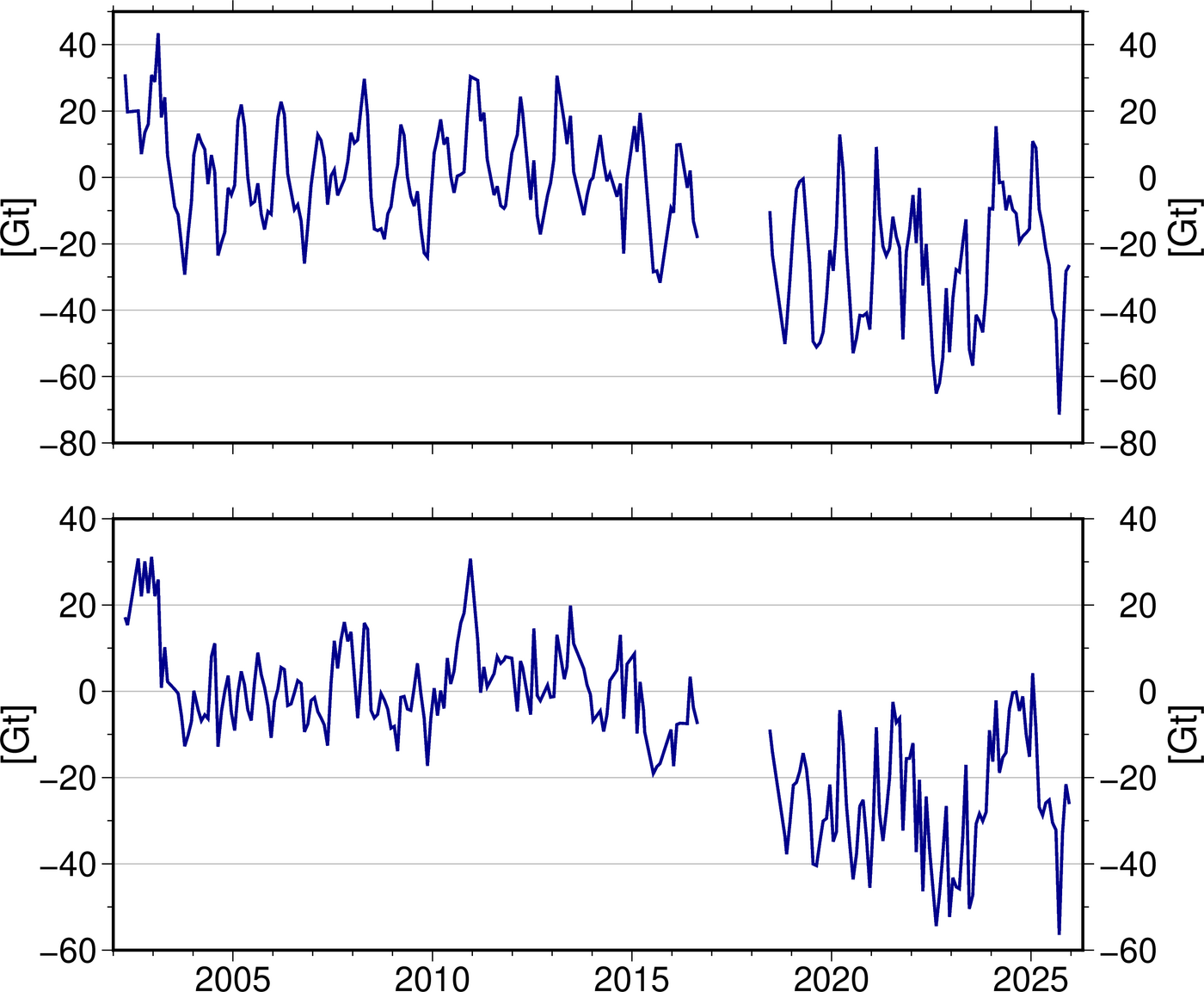
A final look at Germany reveals that the widespread drought that has been ongoing since 2018, and possibly as far back as 2015, is clearly evident. By contrast, 2024 was above average in terms of wetness, with around 15% more precipitation than the long-term average. This allowed water storage levels to recover temporarily. Consequently, they returned to near-normal levels for the first time since 2018.
However, in 2025, precipitation was once again significantly below average at -18%. Increased evaporation due to high temperatures led to a further reduction in water storage at the same time. By the end of 2025, Germany had accumulated a water deficit of around 25 billion tonnes compared to the average for the period since 2002. By the end of 2023, this figure had 'only' risen to around 10 billion tonnes.