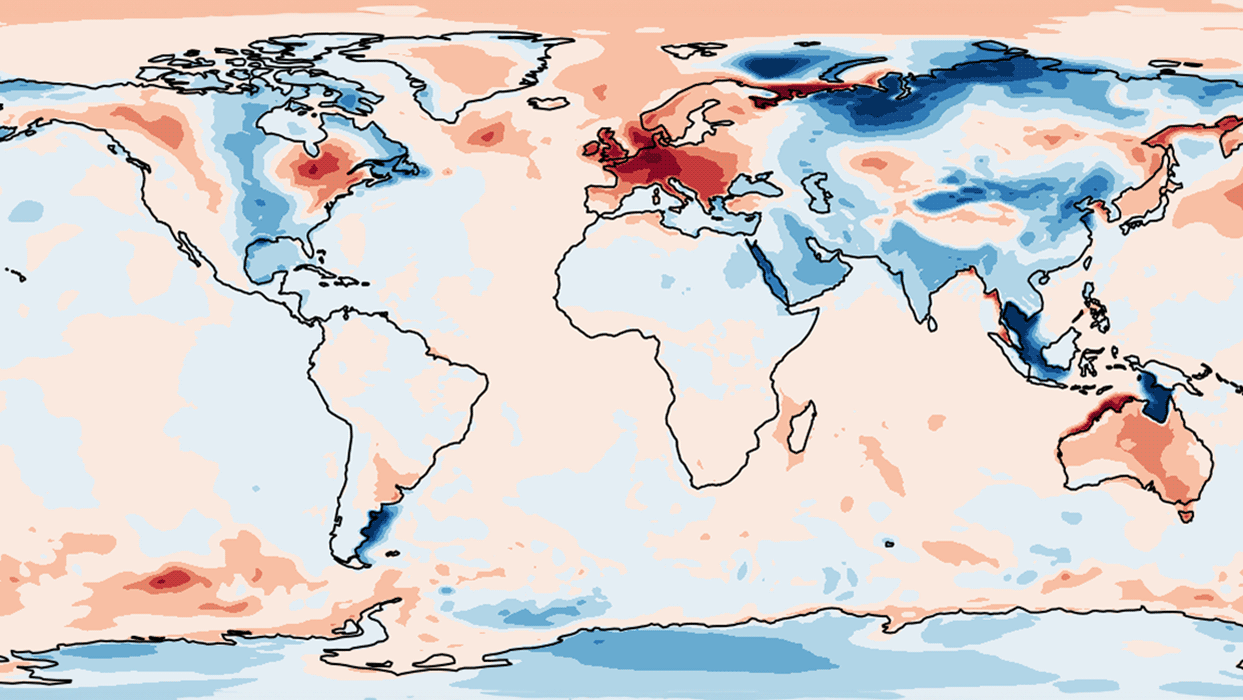
Variations in the atmosphere and oceans also exist on short time-scales. Even though GRACE and GRACE-FO are specifically intended to measure the associated large-scale mass variations on the Earth's surface, a significant portion of these variations are too rapid to be properly captured by the satellites. Instead, they can significantly degrade the measurements. In order to mitigate the impact from the high-frequency mass variations, they are routinely simulated and subsequently subtracted in the GRACE processing to make the measurements usable.
Text: Linus Shihora, GFZ
GRACE and GRACE-FO measurements are an invaluable tool to monitor large scale changes in our Earth system as described here. Apart from the fact that the satellite measurements detect all mass changes, regardless or whether they are visible from the surface or not, the measurements are also truly global thanks to the orientation of the orbits that always pass over the Earth’s rotational poles.
To achieve this global solution at a sufficient accuracy and spatial resolution, however, the GRACE measurements need to be accumulated for typically one month. Only then is a final monthly solution computed.
This, however, poses the problem that not all mass changes in the Earth system occur on monthly time-scales but some on higher frequencies as well. Most prominently this includes ocean tides but also variations in the atmosphere or the general ocean circulation occur on sub-monthly time-scales. These high-frequency signals can not be resolved through the GRACE measurements and instead enter the data as noise that degrades the final monthly solutions. This phenomenon is generally referred to as temporal aliasing.
Animation: Variations in atmospheric pressure at the Earth's surface
An illustration of the problem is given in the animation above. It shows the variation in atmospheric surface pressure and the groundtrack for the GRACE-FO satellites for the first week of 2019. The satellite groundtrack pattern shows why GRACE data is usually accumulated for an entire month. For shorter periods, the Earths surface is not sampled densely enough and as a result the spatial resolution of the final gravity solutions would have to be much coarser. In addition, the animated changes in the atmospheric surface pressure demonstrate the difficulty due to temporal aliasing. While it takes a few days until the satellites re-visit a certain area of the Earth, the atmospheric mass in that region has changed a lot during that time interval. A variation that is not sampled by the satellites is also not recoverable from the GRACE measurements.
The common approach to dealing with temporal aliasing is to simulate these high-frequency variations using global models and then subsequently subtract the signals from the GRACE measurements. While tides are treated separately, non-tidal variations in both the atmosphere and the ocean are routinely predicted by the GFZ and provided to all international GRACE processing centres as the AOD1B data-set since the launch of the original GRACE mission back in 2002.
AOD1B consists of atmospheric reanalysis data, i.e. data from an atmospheric model that is constrained through a large amount of observations and thus aims to provide the best representation of the state of the atmosphere over long time-scales. Combined with simulations using the MPIOM ocean model which is developed by the Max-Planck-Institute of Meteorology and adapted for AOD1B by the GFZ. The AOD1B time-series is simulated and extended routinely every day and made publicly available to the GRACE processing centres but is also applied in a variety of other geophysical applications like the calculation of vertical deformations of the lithosphere due to surface loading, or the prediction of Earth orientation changes in response to mass transports in atmosphere and oceans.
An example of the final data product is given in the animation below, which shows the variations of atmospheric mass over land and oceanic mass over the oceans for the entire month of January 2019.
Animation: Mass fluctuations of the atmosphere and oceans in January 2019
To support also the processing of Satellite Laser Ranging (SLR) observations that are collected at more than 30 stations distributed all over the world including the Telegrafenberg, AOD1B has been extended backwards to the year 1975, when the first dedicated SLR satellites were launched. It is therefore possible to process also the whole SLR data record consistently to GRACE/GRACE-FO, which offers the unique opportunity to infer (low-resolution) information on mass changes that happened on Earth over the past 50 years.